You have verified your API Key, triple-checked your Secret, and matched your endpoints, but your trading script still crashes with: {"code":10211, "msg":"Signature mismatch."}.
In the 2026 algorithmic landscape, migrating an investment strategy from Binance or Bybit to MEXC often results in this exact cryptographic wall. MEXC’s V3 API engine enforces an exceptionally rigid parameters sorting sequence that differs from standard CCXT implementations. A single misordered query string variable will instantly flag your payload as compromised. Here is the definitive guide to debugging Error 10211.
The Structural Mechanics Behind MEXC Error 10211
Through professional multi-asset technical market analysis in 2026, we have isolated the top three structural reasons why MEXC returns a 10211 failure:
- The ASCII Ordering Traps: Unlike exchanges that accept arbitrary payload arrays, MEXC demands that all request parameters be ordered strictly by their ASCII code order before generating the HMAC SHA256 hex digest. If
symbolis appended beforerecvWindow, the signature fails. - The
timestampExecution Window: MEXC is highly sensitive to server-time drift. If your system clock is out of alignment by even 1000ms, the signature will be discarded as expired before the verification layer computes the hash match. - Raw Body vs. Query Parameters: For
POSTrequests (like placing an order), your script must sign the literal query string structure appended to the URL, not the JSON encoded body array inside the payload request.
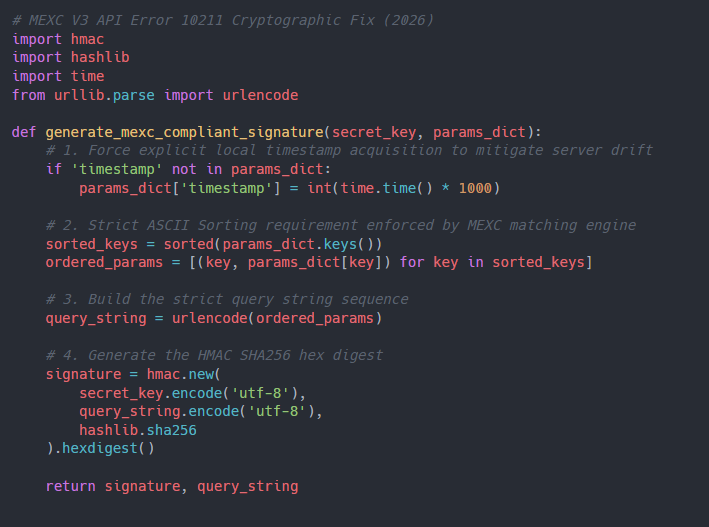
The Technical Fix: Strict ASCII Sorting Wrapper
To secure continuous market execution on MEXC without hitting signature blocks, your trading framework must implement a rigid sorting decorator. Use this production-grade Python solution to enforce strict cryptographic ordering natively.
Enhancing Execution Stability: Multi-Venue Asset Routing
Relying entirely on a single secondary exchange infrastructure during high-volatility trading sessions exposes your algorithmic operations to profound execution risks. Professional quantitative desks handle counterparty exchange-side downtime by deploying verified, high-RPS failover avenues.
The Pro-Trader Optimization Blueprint:
- The High-Frequency Alternative (Bitget): When custom signature constraints or API throttling loops disrupt your execution, instantly switch your liquidity to Bitget VIP Quant Routing ($80 Bonus), engineered for robust institutional sub-account tracking.
- Advanced Web3 Interoperability (OKX): Streamline complex algorithmic portfolios across non-custodial decentralized protocols and deep liquidity books via the OKX Partner Network.