It’s 2026, and tax compliance for crypto assets is no longer optional. You log into Koinly, CoinTracker, or CryptoTaxCalculator, plug in your read-only API keys from major exchanges, and hit “Sync.” Instead of a clean portfolio breakdown, you are met with missing cost-basis warnings, “API Connection Timed Out,” or balance mismatches.
For high-frequency algorithmic traders and multi-asset investors, manual formatting is out of the question. Here is the definitive guide to hardening your exchange API connections for seamless 2026 tax syncing.
The Core Reasons Why Tax APIs Fail
Tax platforms use automated scripts to poll your transaction history. They consistently fail due to three exact infrastructural roadblocks:
- The 3-Month Historical Horizon: Many exchange REST endpoints only return the last 90 days of spot/futures history via standard queries. Legacy transactions require accessing archive endpoints or manual CSV combination.
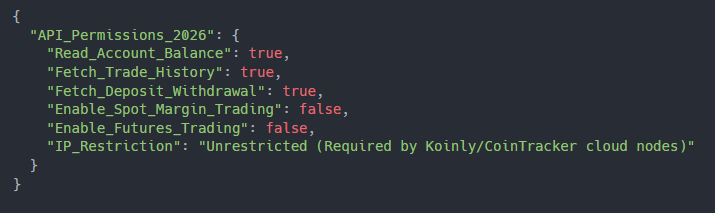
- The Permission Trap: Tax software only requires Read-Only (Fetch/Auditing) permissions. If you accidentally check “Enable Spot” or “Enable Futures” while creating the key, your exchange’s risk engine may flag the connection as a security anomaly and shadow-ban the IP requesting the data.
- Sub-Account Isolation: If you run automated bots across multiple sub-accounts on platforms like Bitget or OKX, a master account API key will not automatically pull sub-account data. Each sub-account must feature its own isolated read-only infrastructure.
Step-by-Step API Hardening for 2026 Tax Syncing
Step 1: Configuring Strict Read-Only Boundaries
When generating your API key for tax purposes, toggle only the data-fetching parameters.
Step 2: Handling High-Volume Webhook & Pagination Errors
If your bot executes thousands of trades a day, Koinly’s automated scraper will hit a rate limit (429 Too Many Requests).
To bypass this, execute a quick Python pre-fetch script using CCXT to aggregate your daily logs into a flattened JSON/CSV file before uploading. This eliminates API throttling entirely.
Upgrading to Developer-Friendly Venues in 2026
If your current exchange makes it impossible to cleanly pull tax histories without data loss, it’s a structural risk to your operations. Institutional traders migrate to venues that prioritize native tax API reliability.
- For Massive Data Integrity (Binance): Offers dedicated historical data centers accessible through verified portals. Scale up via the Binance Developer Gateway.
- For Seamless Sub-Account Auditing (Bitget): Bitget’s 2026 V2 architecture allows unified tax key creation across all sub-accounts simultaneously. Activate your access with Bitget VIP Quant Routing ($80 Bonus).
- For Web3 & On-Chain Tracking (OKX): Seamlessly pairs your OKX exchange API history with on-chain Base/Solana wallet tracking in a single interface via the OKX Elite Portal.