It’s 2026, the market is in a high-volatility surge, and your high-frequency bot suddenly halts. You check the logs, and there it is: pybit.exceptions.InvalidRequestError: Internal error. (ErrCode: 10001).

This isn’t just a technical glitch; it’s a missed opportunity. When Bybit’s matching engine is overwhelmed, Error 10001 is the “white flag” it waves. Here is how to handle it like a pro.
Why does Error 10001 Happen?
Unlike parameter errors, 10001 is a Server-Side error. It usually triggers during:
- Extreme Volatility: Sudden BTC price spikes causing order book congestion.
- API Gateway Overload: Too many requests hitting the unified margin engine.
- Scheduled Maintenance: Minor backend updates that weren’t fully synced.
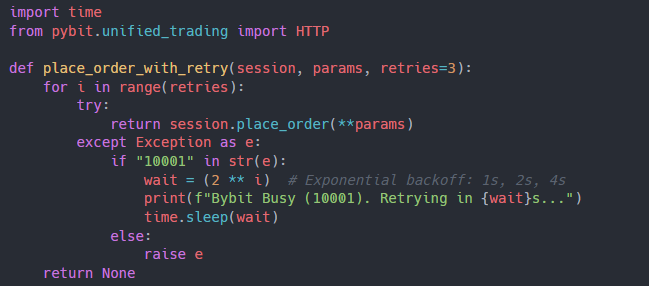
The Technical Fix (The “Retry” Strategy)
You cannot “fix” Bybit’s servers, but you can make your bot resilient. Hard-coding a simple retry logic with Exponential Backoff is mandatory.
The 2026 Institutional Solution: Multi-Exchange Failover (The Upsell)
Professional quant funds in 2026 no longer rely on a single exchange. If Bybit throws 10001, your capital is trapped. The industry standard is now Failover Redundancy.
Why Quants are moving to Bitget during Bybit outages:
- Higher RPS (Requests Per Second): Bitget’s 2026 infrastructure handles congestion more gracefully.
- Lower Latency: Optimized for institutional sub-accounts.
- Developer Incentives: Dedicated API support and high-volume rebates.
Summary & Emergency Links
Don’t wait for the next “Internal System Error” to wipe out your PnL. Set up your redundancy account today.
- Primary Alternative (Bitget): Get VIP API Access & $80 Bonus
- Secondary Backup (Binance): Register via Developer Gateway
- Web3 Connectivity (OKX): Join via Promo Link